
AI Agents for Business: What They Actually Do (And Where Melbourne Companies Get It Wrong)
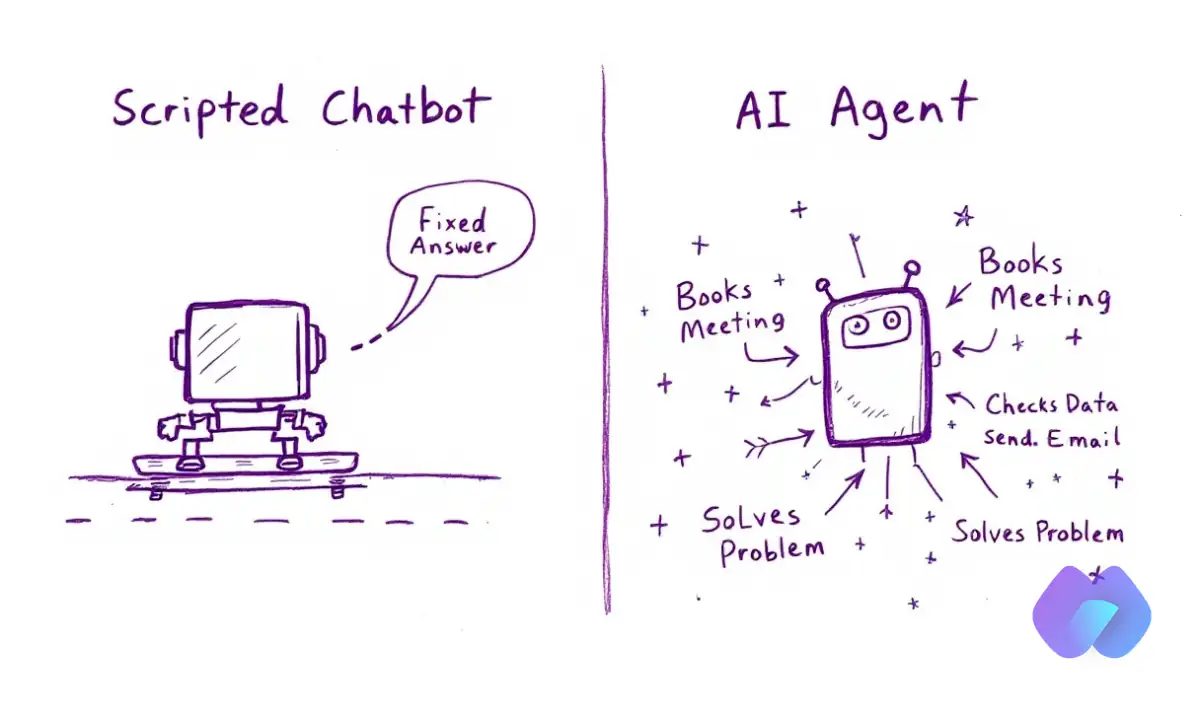
Ask ten business owners what an "AI agent" is and most will describe a chatbot. That's the problem. A chatbot answers questions on your website. An AI agent runs a process: it books the appointment, sends the follow-up, updates the record, and flags the lead for a human, without anyone touching a keyboard. Conflating the two is why so many businesses try one chatbot widget, get underwhelmed, and conclude "AI agents don't work for us." They never actually used one.
The Actual Definition Matters
An AI agent is software that takes an action based on a trigger, not just a query. A customer calls after hours: the agent answers, understands the request, checks availability, and books it into the calendar. A lead fills out a form: the agent qualifies it against your criteria, drafts a personalised reply, and only pings a human if it's genuinely ready to buy.
The difference between this and a chatbot is the difference between a receptionist and an FAQ page:
- Chatbots answer pre-set questions on a page
- AI agents take real actions across your calendar, inbox, CRM and phone system
- The gap between the two is usually where businesses get disappointed with "AI" and give up too early
If your business runs on phone calls, this distinction shows up fastest with missed calls after hours, where a voice agent, not a script-following chatbot, is what actually recovers the lost booking.
Where It Actually Saves Money in 2026
The businesses getting real value from AI agents in 2026 aren't using them to look futuristic. They're using them to close the gaps that cost real revenue: missed calls after hours, leads that go cold because nobody replied within the hour, bookings that fall through admin cracks. These aren't glamorous problems, but they're the ones with a measurable dollar cost attached, which is exactly why they're worth automating first.
Compare that to hiring a part-time admin person to cover the same gaps. A human costs a wage every month whether or not the phone rings. An agent scales with volume and never calls in sick, but it also can't handle genuine judgment calls, so the smart setups route anything ambiguous straight to a person. If you're weighing that trade-off directly, it's worth reading what an AI receptionist actually costs in Australia before assuming either option is out of budget.
Where Melbourne Businesses Get the Setup Wrong
The failure mode isn't the technology, it's the implementation. The mistakes we see on repeat:
- No handoff path. The agent has no clear rule for when to escalate to a human, so it either annoys customers by refusing to help or makes promises it can't keep.
- Bolted onto messy systems. If your calendar, CRM and inbox don't talk to each other already, the agent has nothing reliable to plug into.
- Set-and-forget. An agent needs its scripts and triggers reviewed as your business changes. It's not a one-time install.
- Picking the tool before the process. Businesses buy an AI agent platform first, then try to force their workflow to fit it, instead of mapping the actual process and then building the agent around it.
This is the same trap we see with website chatbots that are supposed to capture after-hours leads but were never given a real handoff rule, so they just politely fail to close the loop.
The Real Question to Ask
Before looking at any AI agent tool, ask: what's the specific gap costing us money right now? After-hours calls going unanswered? Leads sitting for six hours before anyone replies? Bookings requiring three back-and-forth emails to confirm?
An agent built to close one specific, measurable gap will outperform a generic "AI-powered everything" setup every time. If you want the fuller list of where automation actually pays for itself before you commit to any one tool, our breakdown of high-ROI automation ideas for small business is the better starting point than a vendor's sales page.
The Bottom Line
If you're weighing up whether an AI agent makes sense for your business, or you've tried one and it underdelivered, that's usually a systems problem, not an AI problem. An agent is only as good as what it's plugged into.
That's where WebLift comes in. We map the process first, connect the systems that need to talk to each other, then build the agent that runs inside it, not a chatbot bolted on top hoping for the best. Book a free call and we'll tell you honestly whether an agent would actually solve your specific gap.